
 EN
EN
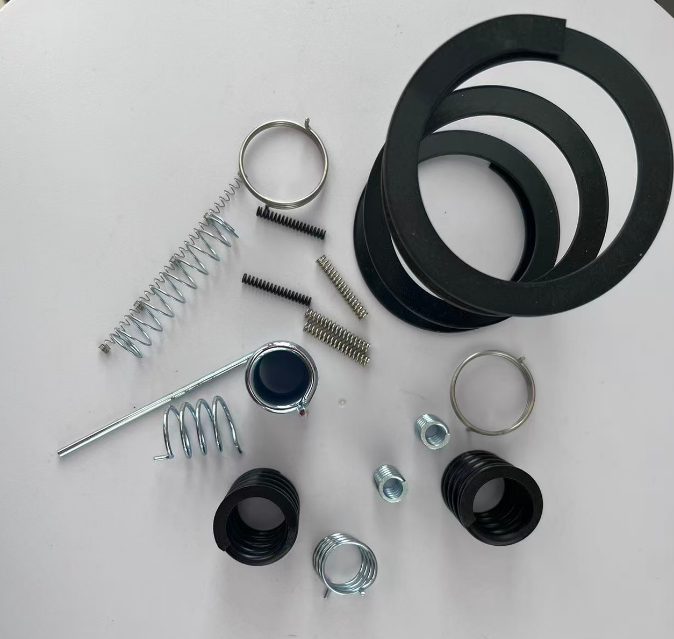
Torsion springs are indispensable mechanical components widely used in automotive parts, household appliances, industrial machinery, medical equipment, and daily hardware. Unlike compression and extension springs that bear linear force, torsion springs withstand rotational torque and store and release rotational energy to achieve functions like resetting, rotating, and clamping.
1. Core Torque Formula for Torsion Springs
T = (E × d⁴ × θ) / (3660 × D × N)
To ensure calculation accuracy, all parameters must adopt unified industry standard units. The detailed definitions are listed below:
-
E (Modulus of Elasticity): Young’s modulus of spring material. For conventional carbon steel and stainless steel spring steel, E = 206000 MPa (fixed value for common spring materials)
-
θ (Deflection Angle): Effective rotation angle of the spring under load, unit: degree (°)
-
N (Number of Active Coils): Effective working coils of the torsion spring (excluding closed end coils and ineffective coils)
In practical engineering applications, we usually need to calculate the torsion spring rate (torque per degree), which represents the torque required for the spring to rotate 1 degree. This parameter is more intuitive for spring selection and structural design.
K = Torsion spring rate, unit: N·mm/°
3. Step-by-Step Torsion Spring Torque Calculation Example
-
Spring material: 304 stainless steel (E = 206000 MPa)
-
Mean coil diameter D = 12mm
-
Working deflection angle θ = 90°
Step 1: Calculate the spring rate K
K = (206000 × 16) / 175680
Step 2: Calculate the final working torque T
The final output torque of this torsion spring at a 90° rotation angle is 1688.4 N·mm.
Based on the calculation formula, we can summarize the core factors that determine torsion spring torque, which can guide you in customizing and adjusting springs:
Torque is proportional to the fourth power of the wire diameter. This is the most sensitive parameter. A slight increase in wire diameter will lead to a sharp rise in spring torque. For example, doubling the wire diameter will increase the torque by 16 times under the same conditions.
Torque is inversely proportional to the coil diameter. The larger the spring coil, the smaller the output torque; the smaller the coil diameter, the greater the torsion force.
The number of active coils is inversely proportional to torque. More active coils mean softer torsion spring and smaller torque; fewer active coils mean harder spring and larger torque.
Different spring materials have different E values. High-strength alloy spring steel has a higher elastic modulus than ordinary carbon steel, so it can provide greater torque with the same size.
In actual calculation and application, many designers make mistakes leading to unqualified spring products. The following key precautions are summarized for reference:
-
Control the deflection angle range: Torsion springs have a safe rotation angle range. Excessive deflection (exceeding the design limit) will cause plastic deformation, resulting in permanent torque loss. The conventional safe deflection range is 0-180°.
-
Consider fatigue loss: For springs working frequently for a long time, 5%-10% torque margin should be reserved in the initial calculation to avoid torque attenuation after fatigue cycles.
6. Frequently Asked Questions (FAQ)
The spring rate (K) is a fixed attribute of the spring, representing the torque per degree of rotation; the torque (T) is a variable value, which changes with the deflection angle. The rate determines the torque output performance of the spring.
This standard formula is applicable to all conventional cylindrical torsion springs with uniform wire diameter and regular coil spacing. It is not applicable for special-shaped torsion springs, variable-diameter springs, and non-standard custom springs, which need finite element analysis for correction.
If the torque is insufficient: appropriately increase the wire diameter, reduce the coil diameter, or reduce the number of active coils. If the torque is too large: reduce the wire diameter, increase the coil diameter, or increase the number of active coils.
Mastering thetorsion spring torque calculation method is the basis of spring design, selection, and customization. By using the standard torque formula and spring rate formula in this guide, you can complete accurate theoretical calculations for most conventional torsion springs. Reasonable torque calculation can effectively avoid spring failure, reduce equipment maintenance costs, and improve the stability of mechanical structures.